How to Take Care of Elderly Parents in India from Abroad
How to Take Care of Elderly Parents in India A step-by-step, expert guide for every NRI navigating health monitoring, emergency planning, verified caregivers, and professional support — so distance never becomes neglect.
The Distance That Keeps 35 Million NRIs Awake at Night
You built a career abroad. You provide financially for your parents. You call them every day. And yet — when you hear that your mother forgot her evening medication, or that your father stumbled getting out of bed — no amount of money wired or calls made fills the gap of not being physically present.
Taking care of elderly parents in India from abroad is one of the defining emotional and logistical challenges of NRI life. India currently has over 138 million people aged 60 and above, and three out of four seniors manage at least one chronic condition such as diabetes, hypertension, or cardiac disease. These are not conditions that resolve with a monthly phone call — they need daily attention, regular monitoring, and immediate response when something goes wrong.
The good news is that with the right plan, the right tools, and the right support system, you can give your parents the care they deserve — even from thousands of miles away. This guide covers every step you need to take, in the right order.
138MIndians aged 60+
75%Have chronic conditions
35M+NRIs globally
60%Informal carers burn out
Step 1 — Understand Your Parents’ Actual Needs Before You Plan Anything
The most common mistake NRI families make is designing a care plan based on assumptions rather than facts. Your parents may be managing better than you fear — or worse than they admit. Either way, clear-eyed assessment is the foundation everything else rests on.
Assess Their Physical Health Thoroughly
Schedule a comprehensive medical check-up — blood work, cardiac assessment, bone density, vision, and hearing — before you finalise any care plan. Get a clear picture of all existing chronic conditions, current medications, their dosages, and refill frequencies. Ask their doctor directly what level of daily support they need, and what warning signs require immediate medical attention. Do not rely solely on what your parents tell you — they will almost always understate their difficulties to avoid worrying you.
BEvaluate Their Day-to-Day Functioning: How to Take Care of Elderly Parents in India
Can they prepare their own meals safely? Are they managing their personal hygiene independently? Do they handle bill payments and errands without difficulty? Are there signs of cognitive change — repeating conversations, forgetting appointments, leaving appliances on? These daily function indicators tell you far more about the level of care needed than a general “I’m fine” over a video call.
How to Take Care of Elderly Parents in India Do Not Overlook Their Emotional Wellbeing
Loneliness and social isolation are among the most underreported — and most damaging — challenges faced by elderly parents living alone in India. Depression and anxiety are common but routinely missed because they manifest subtly: withdrawal from social activities, loss of interest in hobbies, or a persistent low mood that your parents dismiss as “just getting old.” Emotional care is not optional. It is as essential as medication management.
Step 2 — Build a Communication Routine That Actually Works
Consistent, meaningful communication is the emotional backbone of any long-distance care arrangement. But it needs to be structured, not sporadic — and focused on connection, not just health updates.
1.Set Fixed Video Call Times How to Take Care of Elderly Parents in India
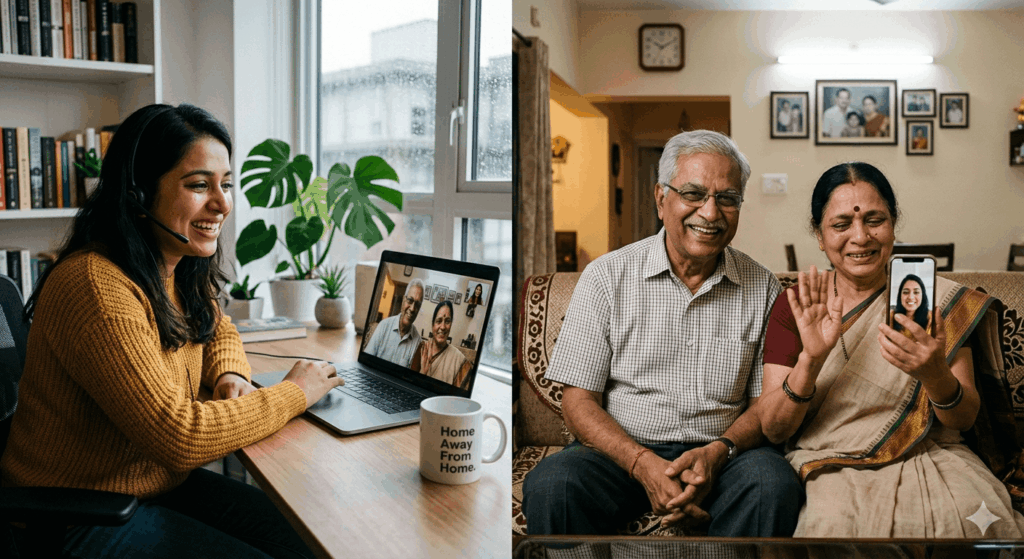
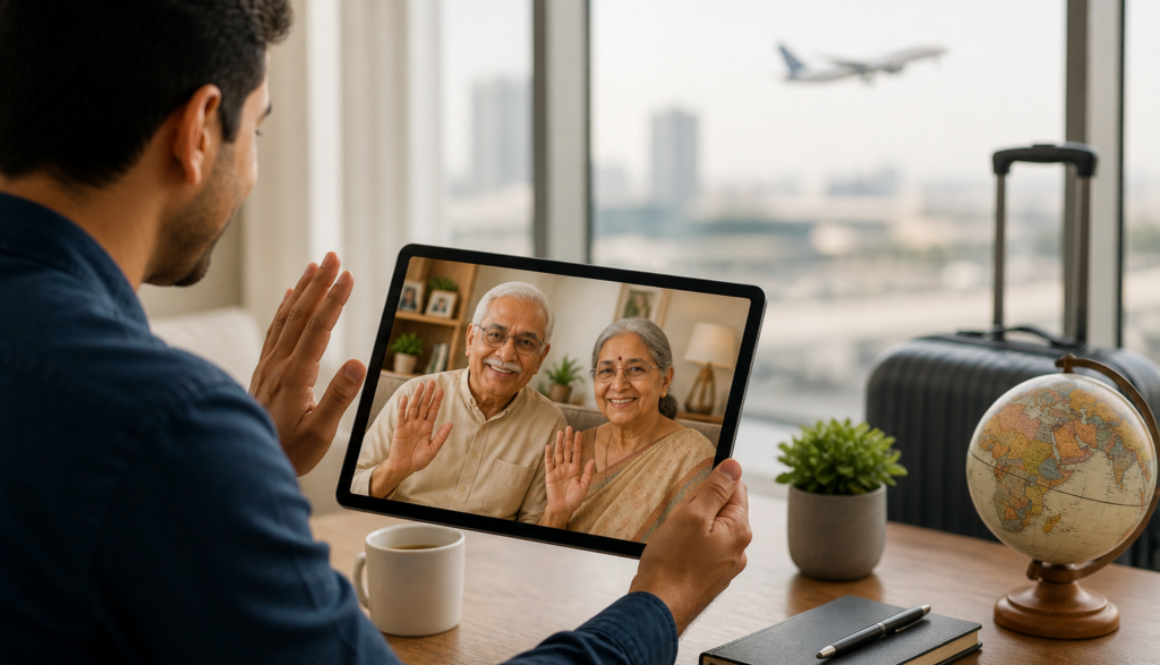
Schedule daily or every-other-day video calls using WhatsApp or FaceTime at a time that works across your time zones. Fixed routines give your parents something to look forward to and ensure you notice changes in their appearance, energy, or mood over time — changes you would miss in a voice call.
2.Create a Family Communication Group How to Take Care of Elderly Parents in India
Set up a WhatsApp group that includes all siblings, any nearby relatives, and your parents’ primary caregiver or care manager. This ensures everyone has the same information, responsibilities are shared, and no single person carries the full burden of coordination from abroad.
3.Go Beyond Health Updates
The most important thing you can give your parents through a screen is your genuine presence. Ask about their week, their friends, the local news, what they ate. Share what is happening in your life. A call that feels like an interrogation about medications is not connection — it is a check-in. Your parents need both, but never forget which one feeds their spirit.
Remember: Most elderly parents actively hide their health struggles, pain, and emotional difficulties from their NRI children. They do not want to be a burden. This is why consistent professional monitoring — not just family calls — is the only reliable way to know what is truly happening day to day.
Step 3 — Put Active Health Management Systems in Place
Managing your parents’ health remotely requires more than scheduling — it requires systems. Chronic conditions do not take weekends off, and a missed dose or an undetected blood pressure spike can escalate rapidly without on-ground oversight.
AMedication Management — The Daily Non-Negotiable
Medication non-adherence is one of the leading causes of preventable hospitalisation among elderly patients in India. Ensure someone on the ground is physically confirming that your parents take their medications at the correct times and in the correct doses — not just leaving pills on the table and hoping for the best. Pill organisers, medication reminder apps, and a trusted caregiver or care manager who tracks refills and flags missed doses are all part of a robust system.
BRegular Vitals Monitoring
For parents managing blood pressure, diabetes, or cardiac conditions, regular vitals tracking is essential. Basic home monitoring equipment — a validated blood pressure monitor, a glucometer — can be set up easily. But the data only matters if someone is recording it consistently, reviewing it against normal ranges, and reporting anomalies to you and to their doctor. Wearable devices now offer fall detection, heart rate monitoring, and real-time alerts — giving you genuine visibility without intrusive surveillance.
CScheduled Medical Check-Ups and Doctor Visits
Quarterly health check-ups — not just visits when something is wrong — are the gold standard for managing elderly health proactively. Ensure your parents have a trusted primary care physician who knows their history. Arrange for someone to accompany them to every consultation, take notes on the doctor’s instructions, and share a written summary with you. Telemedicine platforms now allow you to participate directly in consultations via video — an enormously valuable option for NRI families.
DMaintain a Digital Medical File
Store all medical reports, prescription histories, blood results, and scan reports in a shared cloud folder — Google Drive or a dedicated health app — that you, your siblings, and your parents’ care manager can access instantly. In an emergency, having this information immediately available can save critical minutes and prevent dangerous medication errors during hospital admission.
Step 4 — Build a Verified Local Support Network on the Ground
Technology helps you stay informed. But taking care of elderly parents in India from abroad ultimately requires trusted human beings on the ground. This is the layer that most NRI families underinvest in — and the one that matters most when something goes wrong.
Trusted Neighbours & Friends
Identify two or three people near your parents who can check in regularly and contact you in an emergency. Ensure they have your number, the nearest hospital’s details, and your parents’ blood group and key medical information.
Reliable Domestic Help
A verified domestic worker handles cooking, cleaning, and basic household management. But reliability is everything — unverified help with no accountability is a risk. Background checks and regular supervision are non-negotiable.
A Trusted Local GP
Establish a relationship with a good general physician near your parents’ home. Ensure your parents know how to reach the doctor directly, and that the doctor has your contact details for situations that require family input.
A Professional Care Platform
For complete peace of mind, a professional NRI care service — like NRI Care 360 — acts as your accountable, trained presence on the ground, managing everything from daily check-ins to hospital coordination and 24/7 emergency response.
Step 5 — Create a Written Emergency Action Plan Before You Need It
The worst time to build an emergency plan is during an emergency. When a medical crisis happens at 2 AM in India — which may be late evening or early morning wherever you are — you need to know exactly who to call, in what order, with what information. Panic is not a plan.
Every NRI family needs a single, documented emergency reference document that includes:
- Names and phone numbers of at least two trusted local emergency contacts who can reach your parents within minutes
- The nearest hospital with a 24-hour emergency department, and the route from your parents’ home
- Your parents’ blood groups, known allergies, and current medication list with dosages
- The name and direct number of their primary care physician
- All health insurance policy details, including the insurer’s emergency helpline number
- Your contact details and those of all siblings — visible and accessible in the home
- The contact number for your professional care service’s 24/7 emergency line
- Digital copies of all critical identity documents — Aadhaar, health cards, insurance policies
This document should be stored digitally on shared cloud storage, printed and kept in a clearly labelled folder at your parents’ home, and reviewed and updated every six months. Share it with every person in your local support network.
The NRIs who sleep soundly are not the ones who love their parents most. They are the ones who built the most reliable system around them — before they ever needed it.— NRI Care 360
Step 6 — Get the Legal and Financial Framework in Order
Long-distance care is not only a health challenge — it is also a legal and financial one. Having the right documents and systems in place prevents crisis moments from becoming compounded by avoidable administrative chaos.
ASet Up Power of Attorney
A Power of Attorney (POA) allows a trusted person in India — a sibling, relative, or legal representative — to make decisions and sign documents on your behalf. This is essential for managing property matters, banking transactions, and medical consents when you cannot be physically present. Consult a qualified Indian lawyer to draft a properly executed POA that covers the areas you need.
BEnsure Comprehensive Health Insurance
Less than 2% of elderly Indians currently have adequate health insurance coverage — a statistic that leaves millions of families exposed to catastrophic out-of-pocket medical costs. Senior-specific health insurance plans in India now offer cashless treatment at over 10,000 network hospitals, pre-existing condition coverage after a waiting period, and digital claim processing. As an NRI, you can purchase and manage these policies online and pay premiums from your NRE or NRO account.
CAutomate Bill Payments and Monthly Expenses
Set up automatic bank transfers to cover your parents’ regular monthly costs — utility bills, medical expenses, caregiver fees, grocery allowances. Link your Indian and foreign accounts for seamless transfers. A simple automated system prevents the embarrassing and dangerous situation where a critical payment lapses because you were busy or in a different time zone.
How NRI Care 360 Makes All of This Possible
Building every element of this care framework independently — assessing needs, vetting caregivers, setting up monitoring systems, preparing emergency plans — is a significant undertaking when you are managing it from another country. NRI Care 360 is built precisely to carry this responsibility for you.
Operating across 15+ cities in India and trusted by 500+ NRI families, NRI Care 360 is a complete, professional on-ground support platform — not a call centre, not a referral service, but a dedicated team that knows your parents personally and is accountable for their wellbeing every single day.
Health Monitoring
Daily vitals tracking, medication management, doctor coordination, and structured monthly health reports sent to you anywhere in the world.
Verified Home Visits
Trained, background-checked care staff visiting your parents with photo documentation and written summaries after every single visit.
Hospital & Doctor Support
Appointment scheduling, accompaniment to consultations, hospital admission coordination, and diagnostic test management — fully handled on the ground.
24/7 Emergency Response
Sub-15-minute local team dispatch when a crisis happens — ambulance coordination, real-time family updates, post-emergency follow-up care.
Dedicated Care Manager
One person who knows your parents by name, understands their conditions and preferences, and is personally accountable to you every day.
Daily Assistance & Errands
Groceries, medicine pickups, bill payments, and utility management — handled reliably and reported transparently so nothing falls through the cracks.
Taking Care of Your Parents from Abroad Is a System — Not a Feeling
Loving your parents deeply is not enough to keep them safe from thousands of miles away. Love without structure leaves gaps — in medication management, in emergency response, in daily oversight — that good intentions alone cannot fill.
But taking care of elderly parents in India from abroad is genuinely possible when you approach it the way this guide outlines: starting with an honest assessment of their needs, building communication routines that sustain emotional connection, putting active health management systems in place, creating a verified local support network, preparing emergency plans before they are needed, and getting the legal and financial framework right.
Most importantly, recognise when the situation calls for professional support. A dedicated NRI care platform is not a replacement for your love — it is the infrastructure that makes your love actionable across every time zone, every emergency, and every ordinary Tuesday when your parents need someone to simply be there.
Your parents gave you everything they had. Building a system that truly takes care of them is the most meaningful thing you can give back.
Start Building Your Parents’ Care System Today
Book a free consultation with NRI Care 360. Tell us about your parents, their health, and your concerns — and we will design a care plan built around them, not a template.
Book Free Consultation →Explore Our ServicesPublished by NRI Care 360 — India’s Premium NRI Support Platform · 500+ NRI Families Served · Available across 15+ cities in India · Rated 4.9 by NRI families · 24/7 Emergency Response