
Home Care Services for Elderly Parents in India: The Complete Guide for Families .
Imagine your 72-year-old father navigating a busy Hyderabad hospital corridor alone — papers in one hand, trying to remember the doctor’s room number with the other. Or your mother sitting quietly at home on a Tuesday afternoon, medications untouched because she forgot, and no one nearby to notice. These are not dramatic scenarios. They are the quiet, everyday realities of elderly parents living at home without adequate support in India.
For adult children living nearby, filling these gaps is already demanding. For the millions of NRIs living abroad — and for working families across Indian cities — the challenge is even more acute. The demand for home care services for elderly parents in India has grown enormously over the past decade, and the options available today are far more structured and professional than most families realise.
This guide covers everything you need to know: what home care services actually involve, the different types available, how to evaluate a provider, what quality in-home elder care looks like in practice, and how platforms like NRI Care 360 are redefining what is possible for families who want the best for their aging parents — without compromise.
Why Home Care for Elderly Parents in India Is Growing So Rapidly
The Demographic Reality
India is in the middle of a significant demographic shift. According to government data, India’s elderly population — those aged 60 and above — is expected to reach 300 million by 2050, more than double the current figure. The fastest-growing segment is the “oldest old” — those aged 80 and above — who have the most intensive care needs.
At the same time, the traditional joint family system that once provided built-in elder care is under structural pressure. Urbanisation, nuclear family formation, career mobility, and emigration have all eroded the informal care networks that previous generations relied on. The result is tens of millions of elderly parents living alone or with a spouse — without reliable daily support.
Why Families Prefer Home-Based Care
Despite the growing availability of old-age homes and assisted living facilities in India, the overwhelming preference among Indian families — and among elderly parents themselves — remains care at home. The reasons are deeply practical as well as cultural:
Comfort and Familiarity: Elderly individuals do best in environments they know. Their home holds decades of routine, memory, and identity. Disrupting that has measurable negative effects on cognitive and emotional wellbeing.
Dignity and Independence: Home-based care preserves the elderly person’s sense of autonomy. They continue to live on their own terms, with support arriving around them rather than them being placed within an institutional structure.
Family Proximity: Even when family cannot be present physically, home-based care keeps the elderly parent in the place where family visits, calls, and connections are most natural.
Medical Preference: For many chronic conditions, home-based monitoring and care management produces better health outcomes than institution-based alternatives because it reduces infection exposure, supports routine, and enables more personalised attention.
The Gap Between Need and Supply
The challenge is not that families do not want quality home care for their elderly parents — it is that quality, accountable, professional home care has historically been difficult to find and even harder to trust. The informal market of domestic workers is large, but unverified, untrained, and unaccountable. Families are left hoping for the best with people entering their parents’ homes without formal background checks or structured reporting.
This is the gap that professional elder care platforms — built specifically around quality, verification, and accountability — are now filling.
What Home Care Services for Elderly Parents in India Actually Include
The term “home care” covers a broad range of services. Understanding the different categories helps families identify exactly what their elderly parents need and match that to the right provider.
1. Personal Care and Daily Assistance
This is the foundational layer of home care — support with the activities of daily living that become difficult as physical capacity declines with age.
Personal care services include assistance with bathing and personal hygiene, dressing and grooming, mobility support (helping an elderly person move safely within the home), toileting assistance for those with limited mobility, meal preparation according to dietary requirements, and light housekeeping.
Quality providers deliver these services through trained, verified caregivers — not general domestic workers. The distinction matters enormously for both the safety and the dignity of the elderly person receiving care.
2. Health Monitoring and Chronic Disease Management
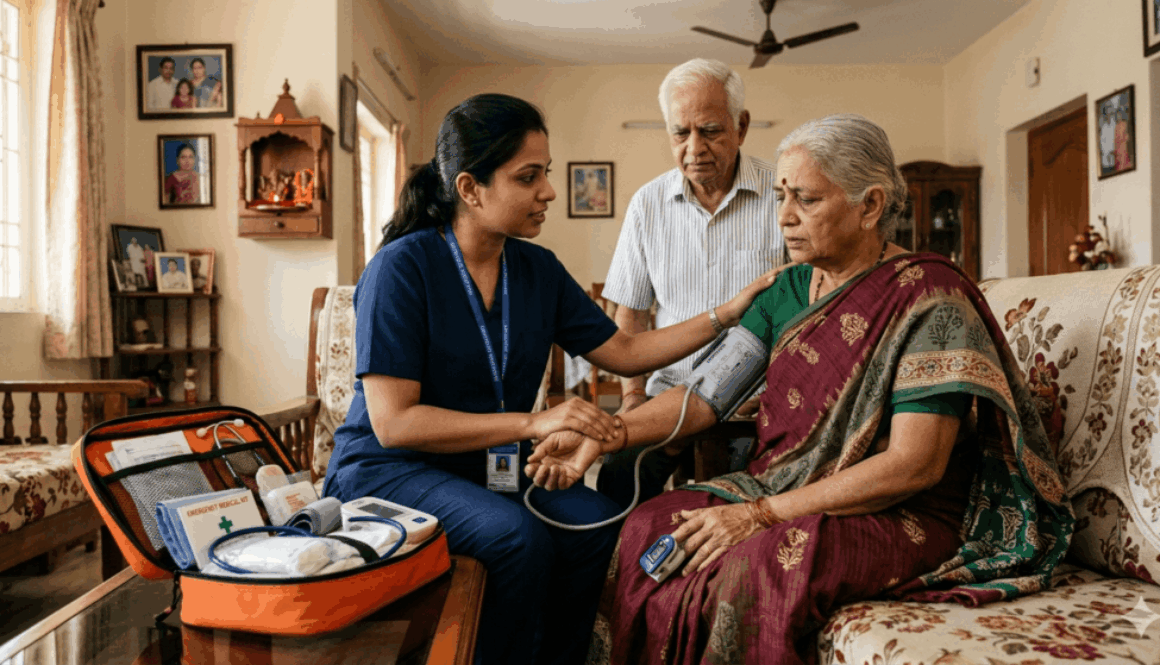
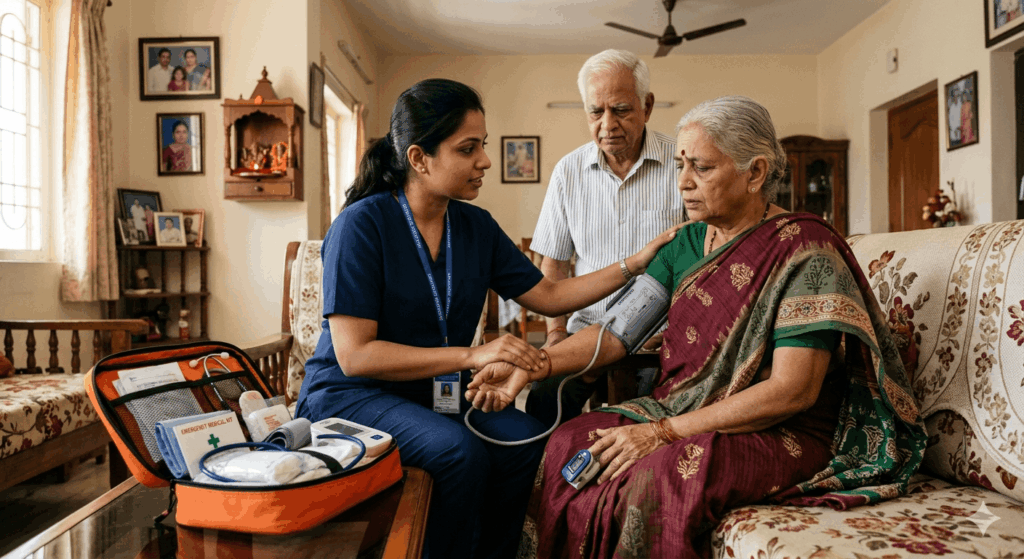
For elderly parents managing hypertension, diabetes, cardiac conditions, or other chronic health issues, daily health monitoring is as important as any medication. Professional home care services include:
- Daily vital checks — blood pressure, blood sugar, oxygen saturation, heart rate — recorded and shared with family
- Medication reminders and adherence tracking — ensuring the right medications are taken at the right time and in the right dose
- Symptom observation — identifying early warning signs of deterioration before they become emergencies
- Weekly health summaries and monthly structured reports delivered to the family via WhatsApp or email
This monitoring layer is what separates professional elder care from simple domestic help. It transforms reactive crisis management into proactive health oversight.
3. Companionship and Emotional Support
Social isolation is one of the most under-discussed and under-addressed risks for elderly individuals living alone in India. Research consistently links loneliness with faster cognitive decline, higher rates of depression, and increased risk of physical health events.
Companionship visits from a trained, compassionate caregiver — conversation, shared activities, walks, and genuine human connection — are not a luxury. They are a critical component of holistic elder care. The best providers train their care staff to go beyond task completion and build real, warm relationships with the elderly individuals they serve.
4. Hospital and Doctor Visit Assistance
For elderly parents managing multiple health conditions, medical appointments are frequent and often complex. Home care services that include hospital and doctor assistance ensure that:
- Appointments are scheduled and confirmed in advance
- Transport to and from the clinic or hospital is arranged and reliable
- A care manager or trained staff member accompanies the elderly parent to the appointment
- Medical reports and doctor instructions are collected and communicated to the family in clear, plain language
- Follow-up actions — prescription refills, diagnostic tests, repeat appointments — are coordinated without gaps
This service has particular value for NRI families, who would otherwise have no one to accompany their parents to appointments or interpret what the doctor recommended.
5. Emergency Response and Crisis Management
A fall in the bathroom. Sudden chest pain. An unresponsive parent at 2 AM. These are the scenarios that every family fears — and for which most families are completely unprepared. Professional home care platforms with emergency response capability offer:
- Rapid local dispatch — trained staff physically reaching the parent’s home within minutes
- Ambulance coordination — arranging emergency transport to the most appropriate hospital
- Hospital admission management — handling the administrative and logistical process of admission so your parent is not navigating it alone
- Real-time family communication — continuous updates to family members throughout the crisis, regardless of time zone
- Post-emergency follow-up — arranging overnight caregiving, follow-up consultations, and ongoing monitoring after discharge
This is the single most critical element of professional home care for NRI families. Without it, all other care arrangements are built on an unstable foundation.
6. Daily Errands and Household Support
Grocery procurement, pharmacy runs for prescription refills, utility bill payments, and general household management — these are tasks that become genuinely difficult for elderly parents living alone, especially those with limited mobility or cognitive challenges.
Professional home care services include coordinating these errands reliably and reporting back to the family. Nothing is left to chance, and nothing is left undone.
How to Evaluate a Home Care Provider for Elderly Parents in India
Not all home care services are created equal. The market includes everything from formal, professionally managed platforms to informal referral networks with little accountability. Here is how to separate quality providers from the rest.
Caregiver Verification and Training
The most important question to ask any home care provider is: How do you verify and train your caregivers? A credible provider will have a formal, documented process for:
- Background checks — police verification, identity verification, and reference checks
- Elder care training — specific training in working with elderly individuals, including health monitoring basics, emergency recognition, and communication
- Ongoing supervision — a structure for monitoring caregiver performance, not just onboarding them
Any provider that cannot clearly answer these questions should not be trusted with access to your parents’ home.
Transparent and Proactive Reporting
A quality home care provider communicates proactively — before you have to ask. This means photo updates after every caregiver visit, written summaries of health observations, prompt alerts when anything changes, and monthly structured reports that give the family a clear picture of their parent’s overall wellbeing.
If a provider only reports when something goes wrong, or requires you to chase them for updates, that is a significant operational and trust failure.
Accountability Structures
Who supervises the caregiver? Who do you call when something is wrong? What happens if the scheduled caregiver does not show up? A professional provider has clear answers to all of these questions — a chain of accountability from caregiver to supervisor to management that ensures reliability, not just best intentions.
Emergency Capability
Ask directly: If my parent has a medical emergency at 3 AM, what happens? A genuine 24/7 emergency response means a local team that physically dispatches, not a call centre that advises you to call an ambulance yourself.
No Hidden Fees
Pricing should be fully transparent. The monthly fee, what it includes, and what constitutes an additional charge should all be documented clearly before service begins. Any provider that is vague about costs should be treated with caution.
NRI Care 360: Premium Home Care Services for Elderly Parents in India
Among the professional elder care platforms now operating in India, NRI Care 360 stands out as one of the most comprehensively designed and purpose-built solutions available — particularly for NRI families whose parents are based in Hyderabad and Secunderabad.
NRI Care 360 was built around a fundamental insight: the challenge facing most families with elderly parents in India is not a lack of love or willingness — it is a lack of trusted, accountable, professional infrastructure. Their platform is that infrastructure.
What Makes NRI Care 360 Different from Standard Home Care Agencies
Built Specifically for Accountability Every element of the NRI Care 360 service model is designed around accountability — not just good intentions. Caregivers are background-verified and trained. Every visit is documented with photos and written reports. Monthly health summaries are structured and detailed. The family always knows what is happening, because the system is designed to tell them.
WhatsApp-First Communication Rather than requiring families to log into portals or download apps, NRI Care 360 delivers all updates, reports, photos, and alerts through WhatsApp — the platform that virtually every NRI family already uses daily. This means communication is immediate, natural, and always accessible.
Relationship-Based Care NRI Care 360 does not treat elder care as a transaction. Their care managers and caregivers build genuine relationships with the elderly individuals they serve. Before formal service begins, the care manager meets your parents in person — building trust face to face before a single formal service is delivered.
24/7 Emergency Response with Local Presence NRI Care 360 maintains a 24/7 emergency response capability with a sub-15-minute local dispatch target. This is not a hotline that coordinates remotely — it is a local team that acts physically, handles everything on the ground, and keeps you updated throughout. When a crisis happens, you receive information — not a request for instructions.
NRI Care 360 Home Care Service Overview
| Service | What Is Delivered |
|---|---|
| Daily Health Monitoring | Vitals tracking (BP, sugar, oxygen), medication adherence, symptom observation, monthly health reports |
| Caregiver Home Visits | Verified trained caregivers, personal care assistance, companionship, photo and written documentation after each visit |
| Hospital & Doctor Assistance | Appointment scheduling, transport, accompaniment, report collection, doctor summary to family |
| Emergency Response | Sub-15 minute local dispatch, ambulance coordination, hospital admission management, real-time family updates |
| Daily Errands Support | Grocery procurement, medicine pickup, utility management, household coordination |
| Dedicated Relationship Manager | Personal care manager assigned, regular home visits, single family contact point, weekly detailed reports |
NRI Care 360 Plans and Pricing
NRI Care 360 offers four structured plans with complete pricing transparency:
Essential Care — ₹14,999 per month Structured health monitoring for independent parents. Includes daily wellness check-ins, medication reminders, weekly vitals, monthly health report, emergency alert coordination, and doctor appointment support. Annual plan: ₹1,49,999 (saves 2 months).
Active Care — ₹24,999 per month (Most Popular) The recommended plan for most families. Everything in Essential Care, plus 2 verified home visits per month, photo and video updates after each visit, doctor accompaniment, medicine and grocery support, and priority emergency response. Annual plan: ₹2,49,999.
Complete Care — ₹39,999 per month For parents with active or multiple health needs. Everything in Active Care, plus 4 home visits per month, full hospital visit management, diagnostic test coordination, a dedicated priority emergency line, and a monthly family review call. Annual plan: ₹3,99,999.
Relationship Manager — ₹59,999 per month The most comprehensive home care plan available. A dedicated relationship manager, 4+ weekly home visits, complete hospital management, a 24/7 priority direct line, household assistance, and detailed weekly reports to family. Annual plan: ₹5,99,999.
No hidden fees. No lock-in contracts. Add-on services are agreed in advance.
Real Stories: What Professional Home Care Looks Like in Practice
When Medication Runs Out
An NRI family in Canada whose parents live in Secunderabad received a WhatsApp message from their NRI Care 360 manager: their parents’ medications were running low and neither parent could travel to the pharmacy. Within 4 hours, the care team had coordinated prescription renewal and arranged doorstep delivery — with the medication schedule updated in the health record. The family never had to make a single call.
When an Emergency Happens at Night
A monitoring alert flagged an abnormal blood pressure reading at 3:20 AM for an elderly mother in Hyderabad. NRI Care 360’s local team reached her home within 12 minutes. A doctor consultation was coordinated by 4:10 AM. The family in the USA received photo updates throughout and woke up to a complete summary — not a panicked voicemail asking what to do.
When Hospital Coordination Is Needed Urgently
An elderly father needed a specialist diagnostic test that required transport and accompaniment. His children were abroad. NRI Care 360’s care manager scheduled the test, arranged transport, accompanied him to the facility, collected the reports, and shared a clear summary with the doctor’s notes — all on the same day. The family received everything they needed without having to coordinate a single step.
Who Needs Home Care Services for Elderly Parents in India?
Home care is not only for elderly individuals with serious health conditions. The need for professional home care exists across a wide spectrum:
Independent but aging parents who are still largely self-sufficient but would benefit from structured health monitoring, medication support, and a trained person checking in regularly — before any crisis occurs.
Parents with chronic conditions such as diabetes, hypertension, or heart disease, who require daily health tracking and consistent medication management to avoid serious deterioration.
Post-hospitalisation recovery — the period immediately following a hospital discharge is one of the highest-risk times for elderly patients. Professional home care during this period dramatically reduces readmission rates and supports a safer recovery.
Elderly parents living alone — whether because a spouse has passed away or because children have moved away, single elderly individuals are at significantly higher risk of undetected deterioration, falls, and social isolation.
NRI families — whose distance and time zone differences make even basic oversight of their parents’ daily wellbeing genuinely difficult without a professional system on the ground.
Frequently Asked Questions About Home Care Services for Elderly Parents in India
How is professional home care different from hiring a domestic worker?
Professional home care involves verified, trained caregivers operating within a formal accountability structure — with documented visits, health monitoring, reporting to family, and supervised performance. A domestic worker provides general household support without training, verification, or any formal reporting structure. The gap between the two is significant, particularly for elderly individuals with health needs.
How quickly can home care services be started?
NRI Care 360 completes its onboarding process — including parent assessment and the care manager’s in-person introduction — within 3 to 5 days from the initial consultation.
Can I start with a lower plan and upgrade later?
Yes. NRI Care 360’s plans are flexible. Families can begin with Essential Care and move to Active or Complete Care as their parents’ needs evolve. There is no penalty for changing plans and no lock-in requirement.
What happens during a medical emergency?
NRI Care 360’s 24/7 emergency response team dispatches locally within a target of 15 minutes. They handle ambulance coordination, hospital admission, doctor communication, overnight caregiving if needed, and continuous family updates — from the moment the emergency begins until full resolution.
Is home care available across all cities in India?
NRI Care 360 currently operates in Hyderabad and Secunderabad, with expansion to Bangalore, Chennai, and Mumbai planned for mid-2026.
Conclusion: Your Parents’ Home Is Where the Best Care Begins
Home care for elderly parents in India is no longer an informal arrangement held together by goodwill and good luck. The professional home care sector has matured significantly, and platforms like NRI Care 360 now offer the kind of structured, verified, and genuinely accountable in-home care that families — both in India and abroad — have long needed but struggled to find.
Your parents built their life in their home. They deserve to age there with dignity, comfort, and the confidence that someone reliable is always nearby — even when you cannot be. The right home care service does not replace the love and presence of family. But it fills the operational gaps that distance, time, and the realities of modern life inevitably create.
Do not wait for a crisis to put a care system in place. The best time to start is before you need it urgently — and the easiest first step is a single conversation.
Book Your Free Consultation with NRI Care 360 Explore All Home Care Services WhatsApp the Team Directly
NRI Care 360 is currently serving families in Hyderabad and Secunderabad. Expansion to Bangalore, Chennai, and Mumbai is planned for mid-2026.