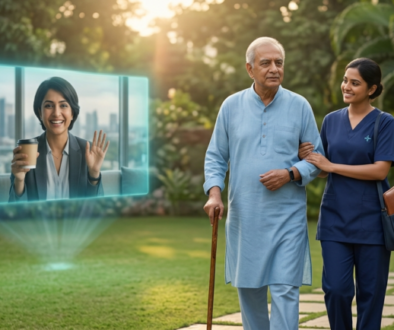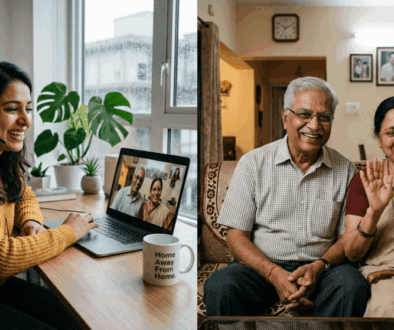
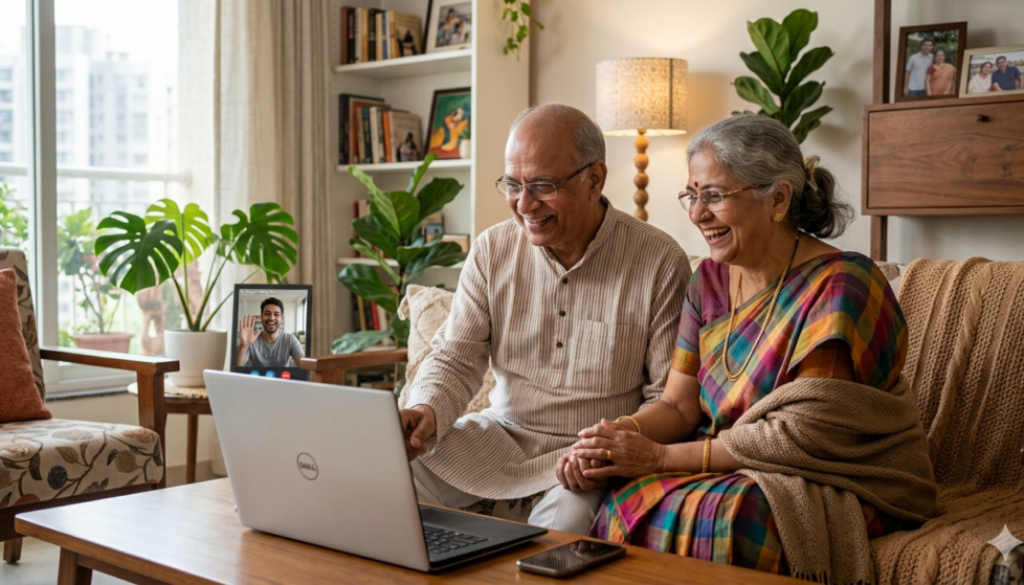
How to Take Care of Elderly Parents in India from Abroad — Complete NRI Guide 2026
The NRI Reality — Why Distance Makes Caring So Genuinely Difficult
There are over 35 million Non-Resident Indians living across the world. Most of them carry a quiet, persistent weight — the awareness that their parents are ageing in India while they build lives abroad. This is not a niche problem. It is one of the most widespread, emotionally demanding challenges faced by the Indian diaspora.
You call every day. You send money. You visit when you can. And yet, there is always a gap — a sliver of uncertainty between the last phone call and the next one. Did Amma take her blood pressure medication this morning? Is Nanna feeling lonely? What happens if there is an emergency at 2 AM India time, which is 3:30 PM where you are?
Most NRIs manage this uncertainty through a patchwork of informal arrangements — a neighbour who checks in occasionally, a relative who lives nearby, a domestic helper who may or may not be reliable. These arrangements feel sufficient until the day they prove inadequate. A missed medication. A fall that goes undiscovered for hours. A hospitalisation that happens while you are asleep on the other side of the world, and by the time you find out, critical decisions have already been made without you.
The hard truth: The problem is never a lack of love or intent. It is a lack of infrastructure. Phone calls are not monitoring. Occasional visits are not continuous care. A neighbour’s goodwill is not emergency response. Taking care of elderly parents in India from abroad requires a system — not a workaround.
My father fell at 11 PM. I was in Sydney. By the time I figured out who to call, two hours had passed. I needed someone already there — not someone I had to wake up and explain the situation to.— NRI family, served by NRI Care 360 Hyderabad
The 5 Biggest Challenges NRIs Face in Caring for Parents in India
Before building a solution, it is important to name the problems with precision. These are the five most commonly reported challenges among NRIs managing elderly parents in India from abroad — and each one requires a specific, structured response.
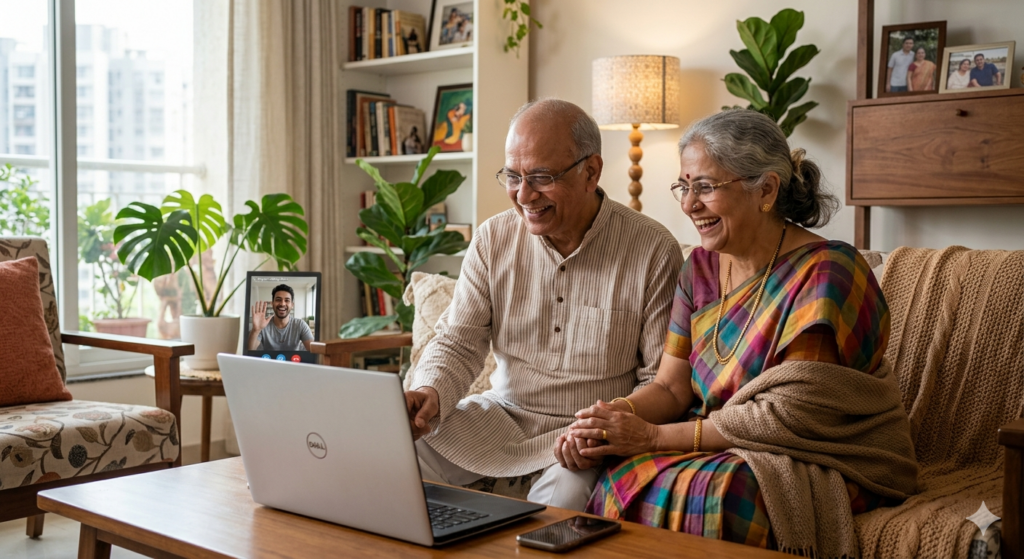
1. Health Goes Unmonitored Daily
Chronic conditions — hypertension, diabetes, cardiac disease, arthritis — are not occasional concerns. They require daily attention. Blood pressure must be checked. Medications must be taken at the correct times and in the correct doses. Blood sugar levels must be monitored. Without someone physically present and consistently accountable for this, small deviations from a care plan compound silently over days and weeks until they become a serious medical event.
Phone calls cannot catch a blood pressure reading. Video calls cannot confirm that the right tablet was taken at the right time. The only solution is structured daily monitoring by a trained, accountable professional — someone who records, reports, and escalates when something changes.
2. Emergencies Happen Across Time Zones Without Warning
A cardiac episode in Hyderabad at 2 AM India Standard Time is happening at 3:30 PM Eastern Time, or 9:30 PM London time, or 5 AM Sydney time. Whatever the hour, the distance means you cannot act. You can panic. You can make phone calls. But you cannot physically be there in the minutes that determine outcomes.
Emergency response requires someone already local — already on the ground — with the authority, training, and relationships to dispatch help within minutes. Calling an ambulance from abroad, navigating an unfamiliar hospital system, coordinating with doctors who do not know you — this is not a plan. It is a series of compounding failures under pressure.
3. Daily Needs Accumulate Into Decline
Medicines run out and are not restocked. Doctor follow-up appointments are missed because there is no transport. Grocery shopping becomes difficult when mobility decreases. Utility bills go unpaid because online banking is confusing. These are individually small problems. Collectively, they accumulate into a declining quality of life that is invisible over a phone call — until one visit reveals how much has changed since the last.
4. Informal Arrangements Are Unreliable and Unaccountable
The vast majority of NRI families rely on some form of informal care arrangement — a domestic helper, a nearby relative, a neighbour who has agreed to check in. These arrangements are built on goodwill, and goodwill is inconsistent. The helper takes days off without notice. The relative has their own family responsibilities. The neighbour is willing but untrained and unable to handle a medical situation.
More critically, informal arrangements have no accountability structure. There is no reporting system. You have no way of knowing whether the medication was taken, whether your parent ate properly, or whether the visit actually happened — beyond a WhatsApp message that may or may not be accurate.
5. NRIs Carry the Emotional Weight Alone
Beyond logistics, there is the emotional dimension of this situation. The guilt of not being there. The anxiety of not knowing. The helplessness of loving your parents deeply while being structurally unable to act on that love consistently. Many NRIs report disturbed sleep, difficulty concentrating at work, and persistent low-level anxiety that is never entirely switched off — because the worry about parents in India never entirely switches off.
This emotional weight is real, and it deserves to be named honestly. The solution to it is not reassurance — it is information, accountability, and the genuine knowledge that someone trustworthy is present for your parents when you cannot be.
How to Take Care of Elderly Parents in India from Abroad — The Complete System
Taking care of elderly parents in India from abroad is entirely possible — not through worry and phone calls, but through a structured, professional system with clear accountability at every level. Here is exactly what that system looks like.
1
Set Up Daily Health Monitoring
The foundation of any remote elder care system is daily, structured health monitoring. This means blood pressure tracked and recorded every morning. Blood sugar levels checked and reported. Medication adherence confirmed — not assumed. Vitals summarised and sent to you each day via WhatsApp with photos. Any anomaly flagged immediately, not at your next phone call. This is the single most important thing you can put in place for parents managing chronic conditions. It transforms your knowledge of your parents’ health from intermittent and anecdotal to daily and documented.
2
Arrange Verified Home Visits by Trained Care Professionals
Physical presence matters in a way that technology cannot replicate. A trained care professional visiting your parents’ home regularly provides something no monitoring device can — human observation, genuine companionship, and the ability to notice the things that are not in any report. Is your parent moving more slowly than usual? Is there an uncharacteristic sadness? Is the home less clean than it should be? These observations only happen through physical presence. Every visit should be documented with a written report and photographs, sent to you immediately after completion.
3
Build a 24/7 Emergency Response Capability
Before any emergency occurs, a local emergency response system must be in place. This is non-negotiable. You need a team that is physically present in the same city as your parents — not a call centre, not a referral network, but an on-ground team that can dispatch within minutes. The response protocol should include: immediate on-site assessment, ambulance coordination, hospital admission management, doctor liaison, and real-time updates to you throughout. Sub-15 minute local dispatch is the standard that actually saves outcomes.
4
Appoint a Dedicated Care Manager Your Parents Know
A care system built around a single, named person who knows your parents — their health conditions, their preferences, their daily routine, their temperament — is categorically more effective than any system built around rotating staff or call-centre coordination. Your dedicated care manager is personally accountable to you. They meet your parents in person before any service begins. They build a genuine relationship over time. And they are the person who acts first when something happens — before calling you, not after.
5
Coordinate Hospital and Doctor Appointments
For parents managing complex or multiple health conditions, hospital visits and doctor consultations are frequent. Scheduling these appointments, arranging transport, accompanying your parent to the consultation, understanding and recording the doctor’s instructions, coordinating diagnostic tests, and managing prescription renewals — this is a substantial logistical load that should not fall entirely on your parents alone. Professional hospital coordination ensures that appointments happen on time, that doctors’ instructions are understood and followed, and that you receive a written summary of every consultation within the same day.
6
Handle Daily Assistance and Errands Reliably
The practical daily needs of elderly parents — medicine pickup, grocery procurement, utility bill payments, domestic help coordination — should be managed through a reliable, transparent system. Not left to chance, not dependent on whoever is available, but handled consistently with confirmation to you after every task. This operational reliability is what prevents the slow accumulation of unmet needs that eventually becomes a visible decline in quality of life.
Informal Care vs Professional Elder Care — An Honest Comparison
Many NRI families have genuine reservations about formalising their parents’ care. Will it feel impersonal? Is it necessary if there is already some local support in place? This comparison addresses those questions directly.
| Dimension | Informal (Neighbour / Relative / Helper) | Professional (NRI Care 360) |
|---|---|---|
| Daily health monitoring | ✗ Rarely consistent | ✓ Every day, documented |
| Medication management | ✗ Unreliable | ✓ Confirmed daily |
| Emergency response | ✗ No structured protocol | ✓ Sub-15 min local dispatch |
| Photo-documented visit reports | ✗ Not provided | ✓ After every visit |
| Hospital accompaniment | ✗ If available | ✓ Fully managed |
| 24/7 availability | ✗ No | ✓ Always reachable |
| Accountability to NRI family | ✗ None formal | ✓ Dedicated care manager |
| Consistency over time | ✗ Depends on individuals | ✓ System-level continuity |
The cost of not having a system
A single preventable hospitalisation in India costs between ₹80,000 and ₹5,00,000 depending on the condition and hospital. One emergency flight from the USA or UK costs ₹1,50,000 to ₹3,00,000. One month of professional elder care is a fraction of either of these. The question is not whether professional care is affordable. The question is whether not having it is.
What NRI Care 360 Does for Your Parents in Hyderabad — Right Now
NRI Care 360 is a premium elder care platform built specifically for Non-Resident Indian families. We are not a referral agency, a call centre, or an aggregator. We are a directly managed care platform — with verified care professionals, structured protocols, and a dedicated manager for every family we serve. We currently operate in Hyderabad and Secunderabad, and have served over 500 NRI families with a consistent rating of 4.9.
Daily Health Monitoring
BP, blood sugar, oxygen levels, and medication adherence checked and documented every day. Monthly health summaries sent to you in your time zone via WhatsApp.
Verified Home Visits
Trained, background-checked care professionals visiting your parents at home in Hyderabad. Photo-documented report sent immediately after every single visit.
Hospital & Doctor Assistance
Appointment scheduling, physical accompaniment, diagnostic coordination, and written summaries of every doctor interaction — shared with you the same day
24/7 Emergency Response
Local team dispatched within 15 minutes. Ambulance coordination, hospital admission, real-time updates to you. Someone already there — not someone you have to find.
Dedicated Care Manager
One named, accountable person who knows your parents personally. They act first in any situation and are directly reachable by you every day.
Daily Assistance & Errands
Medicines, groceries, utility payments, and local errands managed reliably — with confirmation to you after every completed task. Nothing left to chance..
Emergency Preparedness — What to Put in Place Before a Crisis Happens
One of the most consistent findings in elder care research is that NRI families who plan for emergencies before they happen achieve dramatically better outcomes than those who respond reactively. The difference between a crisis that is managed smoothly and one that is traumatic often comes down entirely to preparation. Here is the emergency preparedness checklist every NRI family should complete.
Your Emergency Preparedness Checklist
- Establish a professional 24/7 emergency response service in your parents’ city — not a helpline, but an on-ground team
- Compile a current medication list including dosages, frequencies, and prescribing doctors — shared with your care manager
- Document all known medical conditions and allergy information in written form accessible to the care team
- Identify and register at the two or three hospitals closest to your parents’ home, including emergency contact numbers
- Ensure health insurance documents are up to date and accessible to both parents and the care manager
- Maintain a digital folder of all critical documents — insurance, medical history, property documents — accessible to a trusted local contact
- Establish a clear communication protocol for emergencies — who calls you, at what number, in what sequence
- Brief your dedicated care manager on your parents’ specific health vulnerabilities and any known risks
- Ensure parents have a mobile phone with your number, the care manager’s number, and the emergency line saved at the top of contacts
- Review and update this plan every six months — health situations and local resources change
NRI Care 360 Emergency Response in Hyderabad
Our Hyderabad-based local team dispatches within 15 minutes of any emergency alert — day or night, every day. We coordinate ambulances, manage hospital admission, liaise with doctors, and keep you updated in real time throughout. By the time you know an emergency is happening, our team is already there handling it.
How NRI Care 360 Works — Getting Started in 3 Steps
1. Book a Free 30-Minute Consultation
Scheduled at a time that works in your time zone — whether you are in New York, London, Dubai, or Sydney. We listen to your parents’ current situation, their health conditions, your primary concerns, and your specific care requirements. No sales scripts. No pressure. Honest guidance on what your family actually needs and which plan makes sense for your situation.
2. Parent Assessment and Care Plan Design
Based on your consultation, we create a personalised care plan for your parents — tailored to their specific health conditions, daily routine, and your family’s priorities. Your dedicated care manager then visits your parents in person before any formal service begins. Trust is built face to face, not over email. This introduction visit typically happens within 3–5 days of plan confirmation.
3.Ongoing Care With Full Transparency to You
Daily health monitoring. Scheduled home visits with photo documentation. WhatsApp updates after every visit. Monthly structured health summaries. And when something unexpected happens — our Hyderabad team responds immediately while you are being updated in real time. You receive information, not tasks. You make decisions, not emergency phone calls at 3 AM.
Frequently Asked Questions — NRI Elder Care in India
How can I take care of my elderly parents in India while living abroad?
The most effective approach is to set up a professional elder care system with daily health monitoring, verified home visits, 24/7 local emergency response, and a dedicated care manager who knows your parents personally. Platforms like NRI Care 360 in Hyderabad are built specifically for this — providing structured, accountable, professional care that keeps you informed without requiring you to manage every detail yourself.
What is the most important thing an NRI should set up for parents in India?
Emergency response is the most critical. Before anything else, you need a professional team physically present in your parents’ city that can dispatch within minutes of an alert — not a helpline number you have to call and explain the situation to at 3 AM. Everything else — monitoring, visits, errand support — is important, but emergency response is the non-negotiable foundation.
Is professional elder care better than relying on relatives in India?
Informal care from relatives and neighbours is valuable and should be maintained. But it cannot replace professional care — it is inconsistent, unaccountable, and unsustainable for relatives who have their own lives and responsibilities. Professional care and family support work best together, not as alternatives. The professional system provides the structure and accountability; the family provides the love and emotional connection.
How does NRI Care 360 keep me updated about my parents from abroad?
We provide photo-documented visit reports after every home visit, daily health updates during monitoring, WhatsApp-first real-time communication, monthly structured health summaries, and immediate alerts in any emergency — all shared proactively, in your time zone, without you having to follow up or ask. You receive information; you do not have to hunt for it.
Which areas of Hyderabad does NRI Care 360 serve?
We currently serve Hyderabad and Secunderabad, including Banjara Hills, Jubilee Hills, Ameerpet, Begumpet, Gachibowli, Kondapur, KPHB, Kukatpally, Madhapur, Uppal, Miyapur, Secunderabad, and surrounding areas. Contact us if you are unsure whether we cover your parents’ specific neighbourhood — our coverage is continuously expanding.
Taking Action — What to Do This Week
If you have read this far, something in this guide has resonated with your situation. Perhaps you recognise the informal arrangements you currently have in place and the gaps they leave. Perhaps there has already been a health scare that revealed how inadequate the current system is. Perhaps you are simply tired of the persistent, low-level anxiety that comes from not knowing — truly knowing — that your parents are safe and well today.
Taking care of elderly parents in India from abroad is not about being the perfect NRI child. It is not about guilt or obligation. It is about love translated into action — and action, in this context, means building a system that protects your parents consistently, not just when you happen to call at the right time.
The single most important thing you can do this week is book a free consultation. Tell us about your parents. Tell us what worries you most. We will tell you honestly what you need, what it costs, and what changes the moment NRI Care 360 starts working for your family.