

Who Will Take Care of My Parents in India While I Live Abroad?
The Question Every NRI Carries
Who Will Take Care of My Parents in India You built your career abroad. You gave your children a better future. You send money home every month. But there is one question that sits quietly in the back of your mind — and sometimes, at 2 AM when the phone rings with an unknown India number, it roars to the front: Who is actually there for my parents right now?
This is not a question of love. Every NRI loves their parents deeply. This is a question of infrastructure — of having the right system, the right people, and the right plan in place before something goes wrong. Because something always does.
India is home to over 138 million people aged 60 and above, and that number is expected to double by 2050. Three out of four Indian seniors live with at least one chronic condition — diabetes, hypertension, cardiac disease, arthritis — conditions that demand daily attention and not just monthly phone calls. If your parents are in India and you are not, this guide is for every sleepless night you have spent wondering if they are truly okay.
Why Taking Care of Parents from Abroad Is Genuinely Harder Than It Looks
Most NRIs start with the best intentions — daily video calls, sending money for a domestic helper, asking a nearby relative to check in occasionally. For a while, this works. But as parents age, the patchwork begins to unravel. And the gaps it leaves can be dangerous.
Your Parents Will Not Tell You Everything
This is perhaps the hardest truth for NRI children to accept. Most elderly Indian parents instinctively hide their struggles from their children abroad. They do not want to be a burden. Who Will Take Care of My Parents in India. They minimise symptoms. They say “I am fine” when they are not. By the time you find out something is wrong, the situation is often already serious.
Time Zones Turn Every Emergency into a Crisis
When your father falls at 11 PM in Hyderabad, it is 5:30 AM in London and 6:30 PM in New York. You wake up panicked, disoriented, and thousands of miles from every person who could actually help. Coordinating an ambulance, a hospital admission, and medical decisions from a different continent — without a trusted local contact — is not a system. It is a failure point. Every single time.
Relatives and Neighbours Have Their Own Lives
Depending on extended family or kind neighbours for daily care is understandable but unsustainable. Over 60% of informal caregivers in India report serious anxiety, fatigue, and emotional burnout. The people looking after your parents are not trained, not compensated, and not always available. When they reach their limit — and they will — your parents bear the consequences.
Chronic Conditions Do Not Wait for Your Next Visit
Blood pressure does not stabilise on its own. Diabetes requires daily monitoring and medication adherence. Cardiac conditions need regular check-ups and immediate attention at the first sign of deterioration. These are not problems that a monthly money transfer or a quarterly visit home can solve. They demand daily, on-the-ground presence.
“My father fell at 11 PM. I was in Sydney. By the time I figured out who to call, two hours had passed. I needed someone already there — not someone I had to wake up.
Your Real Options for Parent Care in India — An Honest Assessment
Every NRI family eventually confronts the same three choices. Each has genuine strengths and honest limitations. Here is what they actually look like in practice.
Relying on Family & Relatives
Siblings, cousins, or nearby relatives provide emotional warmth and cultural familiarity. They know your parents personally and genuinely care. But their availability is inconsistent, their capacity is limited, and placing this responsibility on them creates guilt, resentment, and eventual burnout on both sides
Hiring Domestic Help or a Local Nurse
A domestic worker can handle cooking, cleaning, and basic errands. A nurse can assist with medications and physical care. However, finding verified, trained, and reliable help is genuinely difficult. Turnover is high, accountability is low, and there is no one to coordinate between them and you in a medical emergency.
Moving Parents Abroad
For some families, this is the right long-term answer. But visa hurdles are significant, medical costs abroad can be enormous, and most elderly Indian parents deeply resist uprooting from their home, community, and cultural environment. It is also not always financially or logistically feasible.
Professional NRI Care Platform
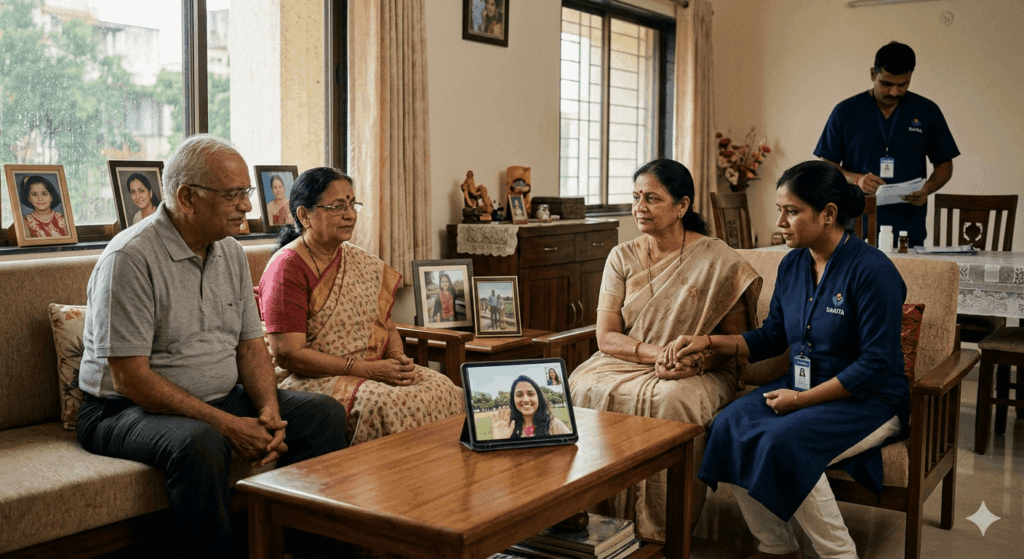
A dedicated elder care service acts as your trusted, accountable presence on the ground — managing health monitoring, medical appointments, emergency response, daily check-ins, and transparent reporting, all coordinated by trained professionals who know your parents personally.
Important: The most common mistake NRI families make is waiting until a crisis happens before putting a care system in place. Reactive care — scrambling to find help after a fall, a hospitalisation, or a health scare — is always more expensive, more stressful, and more dangerous than proactive planning.
What a Complete Parent Care System Actually Looks Like
After years of working with NRI families across the USA, UK, UAE, Canada, Singapore, and Australia, one consistent finding stands out: the most effective NRI parent care is not built on one person or one service — it is built on a structured ecosystem of five interlocking elements.
1. Regular, Meaningful Communication
Not just functional check-ins, but genuine emotional connection. Daily or every-other-day video calls using WhatsApp or FaceTime — focused not just on “have you taken your medicines” but on real conversation, shared memories, and quality time. Consider creating a family group where siblings share updates, photos, and coordinate responsibilities. Your parents need to feel loved, not monitored.
2. Active Medical Management
Medication management is the single most critical daily task for elderly parents with chronic conditions. Ensure someone is tracking that prescriptions are filled, doses are taken on time, and vitals — blood pressure, blood glucose, oxygen levels — are checked and recorded regularly. Schedule quarterly medical check-ups proactively, not reactively. Share all reports digitally so you have complete visibility from wherever you are.
3. Verified, Accountable Local Support
Anyone entering your parents’ home should be background-checked, trained, and professionally accountable. Unverified domestic help is one of the most common sources of risk for elderly people living alone. Insist on documented visits, photo reporting, and clear communication channels that keep you informed after every interaction.
4. A Written Emergency Action Plan
Before anything goes wrong, every NRI family needs a documented emergency plan. This includes the names and numbers of at least two local emergency contacts, the nearest hospitals with emergency departments, your parents’ blood groups, medical history, current medications, and insurance details. This document should be stored digitally, shared with all siblings, and updated every six months.
5. A Dedicated On-Ground Care Manager
This is the element most NRI families are missing. A single person — professionally trained, personally accountable — who knows your parents by name, understands their health conditions and daily routines, and can respond immediately in an emergency. Not a call centre. Not a rotating roster of staff. One dedicated human being who is your trusted proxy in India.
What to Look for in an NRI Elder Care Service
Not all elder care platforms in India are built the same. As you evaluate your options, here is the checklist that separates genuinely reliable services from those that look good on a website but fall short when it matters.
- Verified and background-checked caregivers — not unscreened referrals from a database
- A dedicated care manager assigned personally to your family — not a rotating team
- 24/7 emergency response capability with a sub-15-minute local dispatch time
- Real-time health monitoring with regular vitals reports shared digitally with you
- Transparent visit documentation — photo reports and written summaries after every visit
- Hospital accompaniment and admission coordination — not just advice over the phone
- Medication management including prescription tracking and timely refills
- Clear, consistent communication with the family across time zones
- Pricing that is transparent — no hidden fees or sudden escalations
- Coverage in your parents’ specific city or town — not just major metros
How NRI Care 360 Answers the Question You Have Been Asking
NRI Care 360 was built specifically because phone calls are not enough, relatives have limits, and unverified domestic help is not a system. It is a complete, professional, on-ground support platform — available across 15+ Indian cities — that manages everything your parents need so you can live abroad without constant worry.
Health Monitoring
Daily vitals tracking, medication management, doctor coordination, and monthly health summaries sent directly to you.
Verified Home Visits
Trained care staff visiting your parents — assistance, companionship, errands — with photo documentation after every visit.
Hospital & Doctor Support
Appointment scheduling, accompaniment to consultations, admission coordination, and diagnostic test management.
24/7 Emergency Response
When a crisis happens, our team responds immediately — ambulance, hospital admission, real-time updates to you throughout.
Dedicated Manager
One person who knows your parents personally — their conditions, preferences, and routines — accountable every day.
Daily Assistance
Groceries, medicine pickup, bill payments, and utility management — handled reliably and reported transparently.
Think of NRI Care 360 as your family office in India. Not just a helpline. Not just a caregiver agency. A complete operating system — built for NRIs who refuse to leave their parents’ wellbeing to chance.
The Answer to Your Question
Who will take care of your parents in India while you live abroad? The honest answer is: it depends entirely on the system you build before you need it.
A neighbour cannot be on call 24/7. A relative cannot be expected to coordinate hospital admissions indefinitely without burning out. A domestic helper cannot monitor blood pressure, manage prescriptions, and respond to a cardiac event at 3 AM. These are not failures of character — they are failures of design.
The NRIs who sleep soundly are not the ones who love their parents most. They are the ones who built the most reliable system around them. They have a dedicated care manager. They have a written emergency plan. They have real-time visibility into their parents’ health. They have a platform that responds in minutes — not panicked hours.
That system exists. And it starts with a single decision — to stop relying on hope and start building infrastructure. Your parents gave you everything. They deserve more than a phone call and a prayer.