How NRIs Can Take Care of Parents in India: A Complete Practical Guide
There is a moment most Non-Resident Indians recognise all too well. You are at work in London, or putting your kids to bed in New Jersey, or sitting in a board meeting in Dubai — and your phone lights up with a missed call from home. Your stomach drops before you even see the name. By the time you call back and hear your mother’s voice say “nothing serious, just a small thing” — you already know the weight those words are hiding.
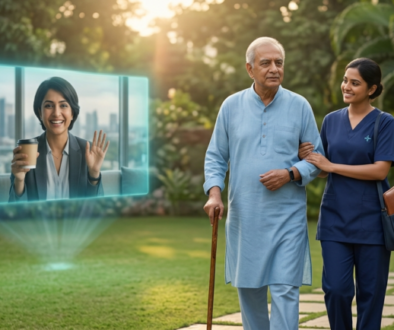
Caring for aging parents from thousands of kilometres away is one of the most emotionally complex and logistically challenging situations an NRI faces. It is not a problem of love. It is a problem of distance, time zones, and missing infrastructure. This guide is designed to solve the practical side — giving you a clear, actionable framework for how NRIs can take care of parents in India, regardless of how far away you live.
The Reality of NRI Parent Care in India: Why Good Intentions Are Not Enough
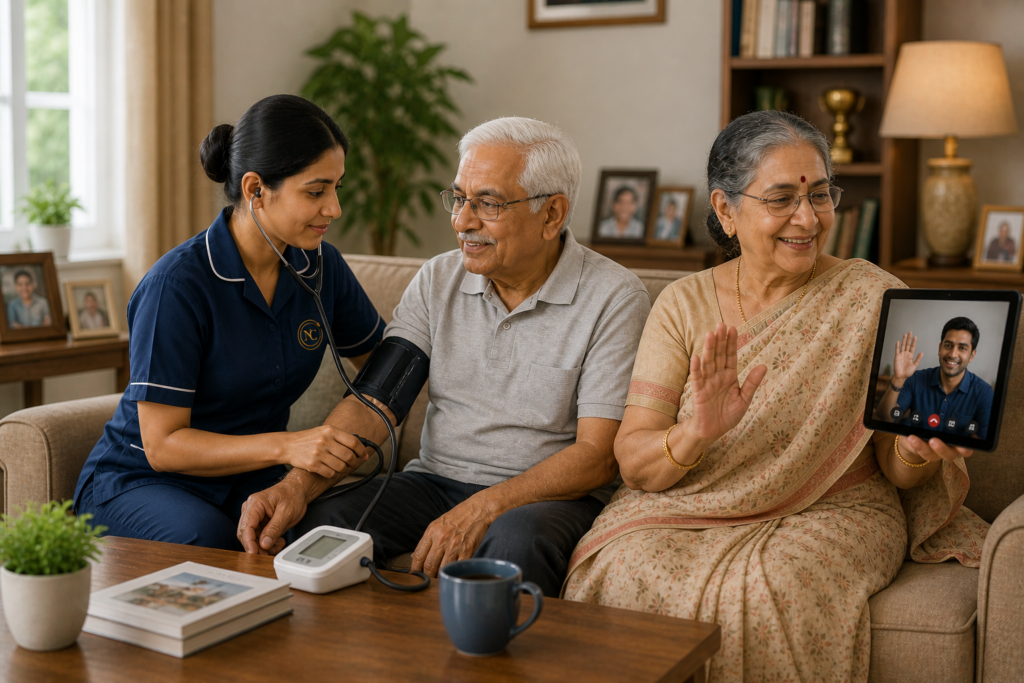
Over 35 million Indians live abroad, and the majority have at least one aging parent living in India. Most of these parents are in their 60s, 70s, or older — an age when health needs intensify, independence becomes fragile, and the risk of a serious medical event is very real.
The challenge is not that NRIs do not care. It is that caring from abroad without the right systems in place is genuinely, structurally difficult.
Why Distance Makes Parent Care So Hard
Time Zone Gaps Create Dangerous Delays India is 5–13 hours ahead of most NRI hubs. An emergency at 3 AM in Hyderabad is the middle of the previous afternoon in New York — or the dead of night in Sydney. By the time an NRI processes the situation, contacts a doctor, arranges transport, and coordinates admission, precious hours may already be lost.
Relying on Neighbours and Relatives Has Limits Most NRI families depend on a loose network of neighbours, relatives, or domestic staff to check in on elderly parents. These individuals are helpful and well-meaning, but they are not trained caregivers, they are not accountable to any formal structure, and they cannot coordinate a medical emergency. This arrangement works until it doesn’t — and when it fails, it fails completely.
Chronic Conditions Require Consistent Management Hypertension, diabetes, and cardiac conditions are extremely common among elderly Indians. These are not one-time health events — they require daily monitoring, medication adherence, and timely medical consultations. Without a structured system, chronic conditions are managed inconsistently at best and ignored at worst.
Your Parents May Not Tell You the Full Picture This is perhaps the most emotionally difficult reality. Indian parents — especially from older generations — tend to underreport health problems to their children abroad. They do not want to worry you. They do not want to be a burden. So a persistent cough, a dizzy spell, a fall in the bathroom, or a missed medication often goes unreported until it becomes a crisis.
How NRIs Can Take Care of Parents in India: 8 Proven Strategies
1. Set Up a Structured Health Monitoring System
The first and most impactful step is to move from reactive to proactive. Instead of waiting for your parents to report a problem, establish a system that monitors their health daily and automatically flags changes.
This means:
- Daily vital checks — blood pressure, blood sugar, oxygen saturation, and heart rate tracked and recorded every morning
- Medication adherence tracking — confirmation that medications are being taken at the right time and in the correct dose
- Weekly health summaries shared with you via WhatsApp or email
- Automated alerts when readings fall outside safe ranges
Professional elder care services like NRI Care 360 provide this as a core service, ensuring you receive real-time updates and monthly structured health reports without needing to chase anyone for information.
2. Arrange Verified Caregiver Home Visits
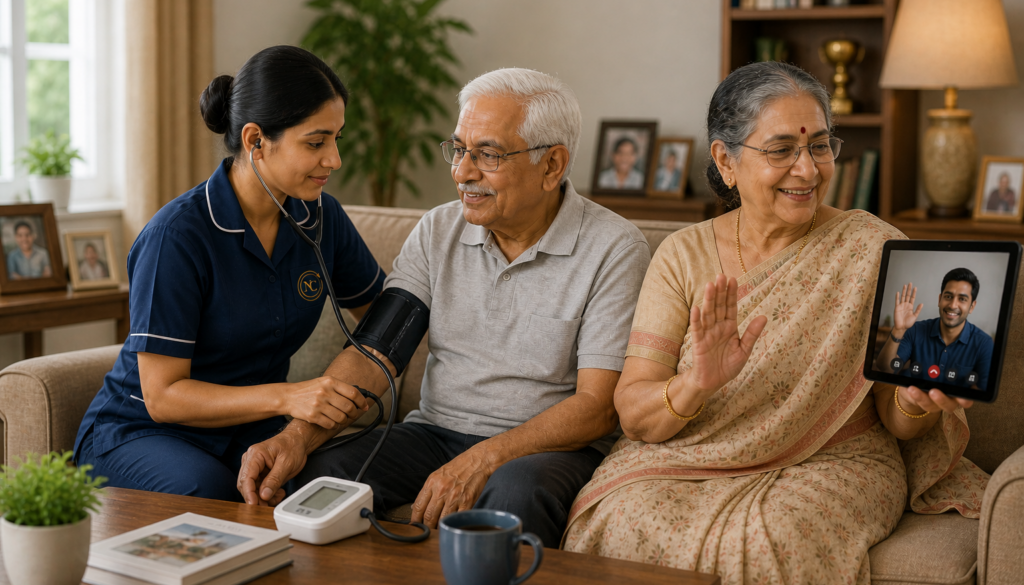
Regular in-person visits by a trained, verified caregiver serve multiple purposes at once. They provide companionship (reducing isolation), in-home health assessment, assistance with daily tasks, and eyes-on accountability that no remote system can replicate.
When arranging caregiver visits, prioritise providers who:
- Conduct formal background verification on all staff
- Provide photo and written documentation after every visit
- Train caregivers specifically in elder care, not just general domestic work
- Operate under a formal accountability structure with supervisors
The key distinction between a professional caregiver and a domestic worker is accountability. A professional caregiver’s visit is documented, reported, and reviewed. A domestic worker’s day largely is not.
3. Establish a 24/7 Emergency Response Capability
This is the single most critical gap in most NRI parent care arrangements. When a genuine medical emergency occurs — a fall, a cardiac event, sudden chest pain, a stroke — you need someone who can physically reach your parents within minutes, not hours.
Building this capability means having:
- A local emergency contact with medical knowledge and authority to act
- An ambulance coordination agreement with a trusted provider
- A preferred hospital and doctor pre-identified, with your parents’ records accessible
- A communication protocol that keeps you updated throughout — not after
NRI Care 360 maintains a 24/7 emergency response system with a sub-15-minute dispatch target. When a crisis occurs, their local team acts immediately — coordinating ambulances, handling hospital admission, and sending real-time updates to the family abroad. You receive information, not requests for instructions.
4. Create a Comprehensive Health and Care Document
Most NRIs carry critical information about their parents’ health only in their heads. This is fragile. Create and maintain a formal document that includes:
- Complete medication list with dosages, timing, and prescribing doctors
- List of all chronic conditions and treatment history
- Contact details for all treating physicians and specialists
- Preferred hospitals and any hospitals to avoid
- Allergies and adverse drug reactions
- Emergency contact priority list (including NRI family members and local contacts)
- Health insurance details and policy numbers
- Blood type and any special medical considerations
This document should be shared with your elder care service provider, accessible digitally, and updated after every significant medical event.
5. Use Technology Wisely — But Don’t Rely on It Alone
Technology is a powerful supplement to professional care, not a replacement for it. Used correctly, it can significantly improve your visibility into your parents’ day-to-day life.
Useful technology tools for NRI parent care:
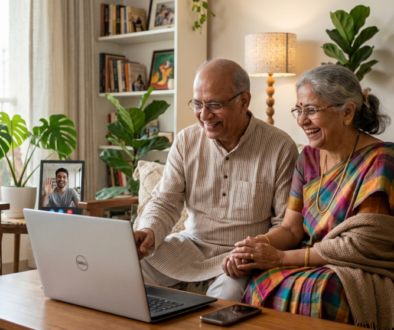
- Video calling (WhatsApp, FaceTime) for daily or every-other-day check-ins — conversation is health monitoring too
- Smart health devices (BP monitors with digital readouts, glucometers with app connectivity) that allow readings to be shared easily
- Location-sharing via smartphone for added safety awareness
- Medication reminder apps or smart pill dispensers for consistent adherence
- CCTV cameras (with consent) in common areas for passive safety monitoring
The limitation of technology is that it cannot act. A camera can show you your parent has fallen — but it cannot help them up, call an ambulance, or stay with them at the hospital. Technology must always be backed by a human response system.
6. Pre-Plan Hospital and Medical Logistics
One of the most chaotic and distressing aspects of a medical emergency is not knowing how things work. Reduce this chaos by pre-planning before an emergency occurs.
- Identify 2–3 trusted hospitals near your parents’ home, with their emergency contact numbers saved
- Choose a primary physician who manages your parents’ overall health and is reachable
- Establish relationships with medical professionals before you need them — your elder care manager can do this on your behalf
- Understand the health insurance coverage your parents have and what it does and does not cover
- Consider a medical emergency fund as a standalone account for health-related expenses
When NRI Care 360 onboards a new family, one of the first steps is a detailed parent assessment — documenting all of the above before service begins. This means that when an emergency occurs, the care manager already has everything they need to act without delay.
7. Address the Emotional and Social Wellbeing of Your Parents
Physical health is visible and measurable. Emotional wellbeing is harder to track — and often neglected in care planning.
Loneliness, loss of purpose, anxiety about being a burden, and grief over their own health changes are real and serious issues for elderly Indians whose children live abroad. Research consistently shows that social isolation accelerates cognitive decline and significantly impacts physical health outcomes.
Practical ways to support your parents’ emotional wellbeing from abroad:
- Schedule consistent video calls at a regular time each day — predictability matters
- Involve them in family decisions wherever possible — it preserves dignity and a sense of relevance
- Arrange social activities — senior groups, religious gatherings, classes, or hobby groups in their area
- Caregiver companionship visits that go beyond task completion — genuinely caring conversations
- Regular WhatsApp updates from you and your children — photos, videos, voice messages — so they feel part of your life even at a distance
8. Engage a Professional Elder Care Platform Built for NRIs
All of the above strategies are significantly more effective when coordinated through a single professional elder care platform built specifically for NRI families. Trying to manage each element independently — finding separate caregivers, monitoring services, emergency contacts, and hospital relationships — is exhausting, unreliable, and full of gaps.
A purpose-built platform like NRI Care 360 integrates all of these elements into one coherent, accountable system with a single point of contact.
Why NRI Care 360 Is the Most Purpose-Built Solution for NRI Families
NRI Care 360 was founded specifically to solve the infrastructure gap that leaves NRI families anxious, reactive, and underserved. Currently operating in Hyderabad and Secunderabad — with expansion to Bangalore, Chennai, and Mumbai planned for mid-2026 — the platform provides a comprehensive, premium elder care service designed around how NRI families actually live.
Core Services That Matter Most to NRI Families
Health Monitoring Daily wellness check-ins, BP and blood sugar tracking, medication adherence monitoring, and monthly structured health reports delivered to the family. When readings fall outside normal ranges, the team responds — proactively, not after being asked.
Caregiver and Home Visits Every caregiver is background-verified and trained. Visits include in-home assistance, companionship, and full photo and written documentation shared with the family after each visit. Your parents are never just a task on a list — they are treated as individuals.
24/7 Emergency Response A local team with a sub-15-minute dispatch capability. When something happens, the team acts — coordinating ambulances, hospital admission, doctor consultations, and overnight caregiving. The family abroad receives real-time updates throughout. You are never waiting and wondering.
Hospital and Doctor Assistance Appointment scheduling, accompaniment to clinics and hospitals, report collection, and doctor summary communication to the family. Your parents never attend a medical appointment alone — and you receive a clear summary of everything that was discussed and decided.
Dedicated Relationship Manager At premium tiers, a dedicated relationship manager is assigned who visits regularly, builds genuine rapport with your parents, and serves as the family’s single trusted point of contact. This person knows your parents’ history, preferences, and needs — not from a file, but from a relationship.
WhatsApp-First Communication Every update, report, photo, and alert is delivered through the channel NRI families actually use — WhatsApp. No apps to install, no portals to log into, no learning curve. Just clear, timely information where you are already looking.
NRI Care 360 Pricing: Clear, Honest, No Surprises
| Plan | Price | Best For |
| Essential Care | ₹14,999/month | Independent parents needing monitoring |
| Active Care | ₹24,999/month | Most NRI families — monitoring + home visits |
| Complete Care | ₹39,999/month | Parents with active or multiple health needs |
| Relationship Manager | ₹59,999/month | Full managed care with dedicated presence |
Annual plans are available with a discount equivalent to two free months. No lock-in contracts. Add-on services are discussed and agreed in advance — no hidden charges, ever.
Building Your NRI Parent Care Plan: A Step-by-Step Approach
Getting started does not need to be overwhelming. Here is a practical sequence:
Step 1 — Assess the Current Situation Have an honest conversation with your parents about their health, daily routines, and any challenges they are facing. Engage a care provider to conduct a formal health assessment.
Step 2 — Identify the Gaps Where is your current arrangement weakest? Is it emergency response? Health monitoring? Social isolation? Identify the two or three highest-risk gaps and address those first.
Step 3 — Engage a Professional Care Provider Book a free consultation with a provider like NRI Care 360. A 30-minute call is enough to understand your options and get an honest recommendation based on your parents’ specific situation.
Step 4 — Create the Health and Emergency Document Work with your care provider to build the comprehensive health record described earlier. This alone removes enormous uncertainty from any future emergency.
Step 5 — Communicate the Plan to Your Parents Involve your parents in the plan. Introduce the caregiver or care manager in person if possible, or via video call. The transition goes more smoothly when your parents feel like participants, not subjects.
Step 6 — Establish Your Communication Rhythm Set a daily or every-other-day call schedule with your parents. Brief, regular contact is more valuable than long, infrequent calls. It maintains connection, detects emotional changes early, and gives your parents something to look forward to.
Frequently Asked Questions: NRI Parent Care in India
Can I set up care for my parents without visiting India?
Yes. NRI Care 360’s onboarding process begins with a remote consultation and completes within 3–5 days, including an in-person introduction to your parents by the care manager on the ground.
What if my parents are resistant to professional care?
This is very common. Most resistance fades once the caregiver or care manager meets the parents in person and builds initial rapport. The transition from stranger to trusted presence typically happens within 1–2 visits.
How will I receive updates about my parents?
NRI Care 360 uses WhatsApp as its primary communication channel — photo updates, written summaries, health reports, and emergency notifications are all delivered there. Proactively, before you ask.
Is professional elder care in India affordable for NRIs?
Plans start at ₹14,999/month. For NRIs earning in USD, GBP, EUR, or AED, this is highly affordable relative to the income differential — and the cost of a single avoidable hospitalisation due to an unmonitored condition will almost certainly exceed several months of care fees.
What cities does NRI Care 360 currently serve?
NRI Care 360 currently serves Hyderabad and Secunderabad, with expansion to Bangalore, Chennai, and Mumbai planned for mid-2026.
Conclusion: From Worry to Reliability — The Shift Every NRI Family Deserves
Caring for your parents from abroad is not impossible. But it requires moving beyond good intentions and informal arrangements into a structured, accountable system that works whether you are awake or asleep, present or in transit, calm or in the middle of a crisis.
The strategies in this guide — structured health monitoring, verified caregiver visits, emergency response capability, comprehensive health documentation, and a professional care platform — are not theoretical. They are the practical infrastructure that turns distance from a source of helpless anxiety into something genuinely manageable.
You chose to build a life abroad. That choice does not have to come at the cost of your parents’ safety or your own peace of mind. The infrastructure exists. The question is whether you put it in place before you need it — or after.
NRI Care 360 exists precisely for this moment. One conversation is all it takes to begin.
Book a Free Consultation — NRI Care 360 Explore Elder Care Services WhatsApp the Team
NRI Care 360 currently serves Hyderabad and Secunderabad. Expansion to Bangalore, Chennai, and Mumbai is planned for mid-2026.